Go back
Go back
Why do people with diabetes neglect foot care, and how might human-centred design intervene before complications arise?
Why do people with diabetes neglect foot care, and how might human-centred design intervene before complications arise?
I designed and evaluated a mobile intervention to support preventive foot care behaviour among people with diabetes, applying user-centred design and behaviour change theory.
I designed and evaluated a mobile intervention to support preventive foot care behaviour among people with diabetes, applying user-centred design and behaviour change theory.
Role
Role
UX Researcher & Interaction designer
· Research & Prototyping
(Academic dissertation- Human-Centred Design approach)
UX Researcher & Interaction designer
· Research & Prototyping
(Academic dissertation- Human-Centred Design approach)
Team
Team
Individual project
(Guided by academic supervision and user research)
Individual project
(Guided by academic supervision and user research)
Supervision
Supervision
Academic dissertation supervised by Mr. Selva Raj. All research, design decisions, and iterations were conducted independently.
Academic dissertation supervised by Mr. Selva Raj. All research, design decisions, and iterations were conducted independently.
Timeline
Timeline
Jan - May 2025
Research phase: 3 weeks of interviews and surveys
Design phase: 3 iterative prototype cycles
Testing phase: 2 rounds of usability testing with 18 participants
Jan - May 2025
Research phase: 3 weeks of interviews and surveys
Design phase: 3 iterative prototype cycles
Testing phase: 2 rounds of usability testing with 18 participants
Research Focus
Research Focus
Key Findings
Key Findings
Semi-structured interviews (n=12) revealed temporal discounting of foot care. Participants described it as "something I'll deal with later" despite awareness of amputation risks.
Semi-structured interviews (n=12) revealed temporal discounting of foot care. Participants described it as "something I'll deal with later" despite awareness of amputation risks.
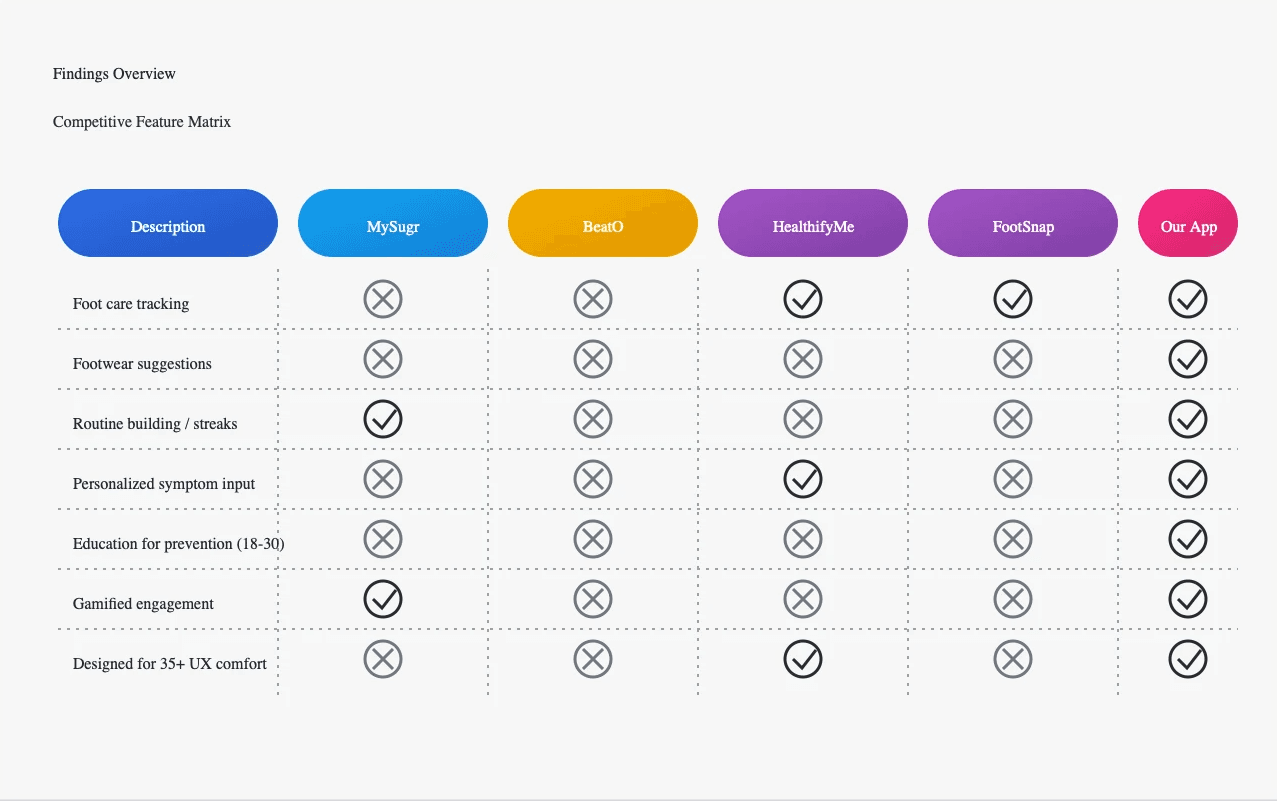
Competitive analysis of 7 diabetes apps found zero dedicated foot care features; footwear guidance was entirely absent.
Competitive analysis of 7 diabetes apps found zero dedicated foot care features; footwear guidance was entirely absent.
Evaluation Outcomes
Evaluation Outcomes
90%
indicated likelihood to recommend to family members
Indicated likelihood to recommend to family members
indicated likelihood to recommend to family members
83%
Test participants engaged with the prototype at least twice within 3 days
Test participants engaged with the prototype at least twice within 3 days
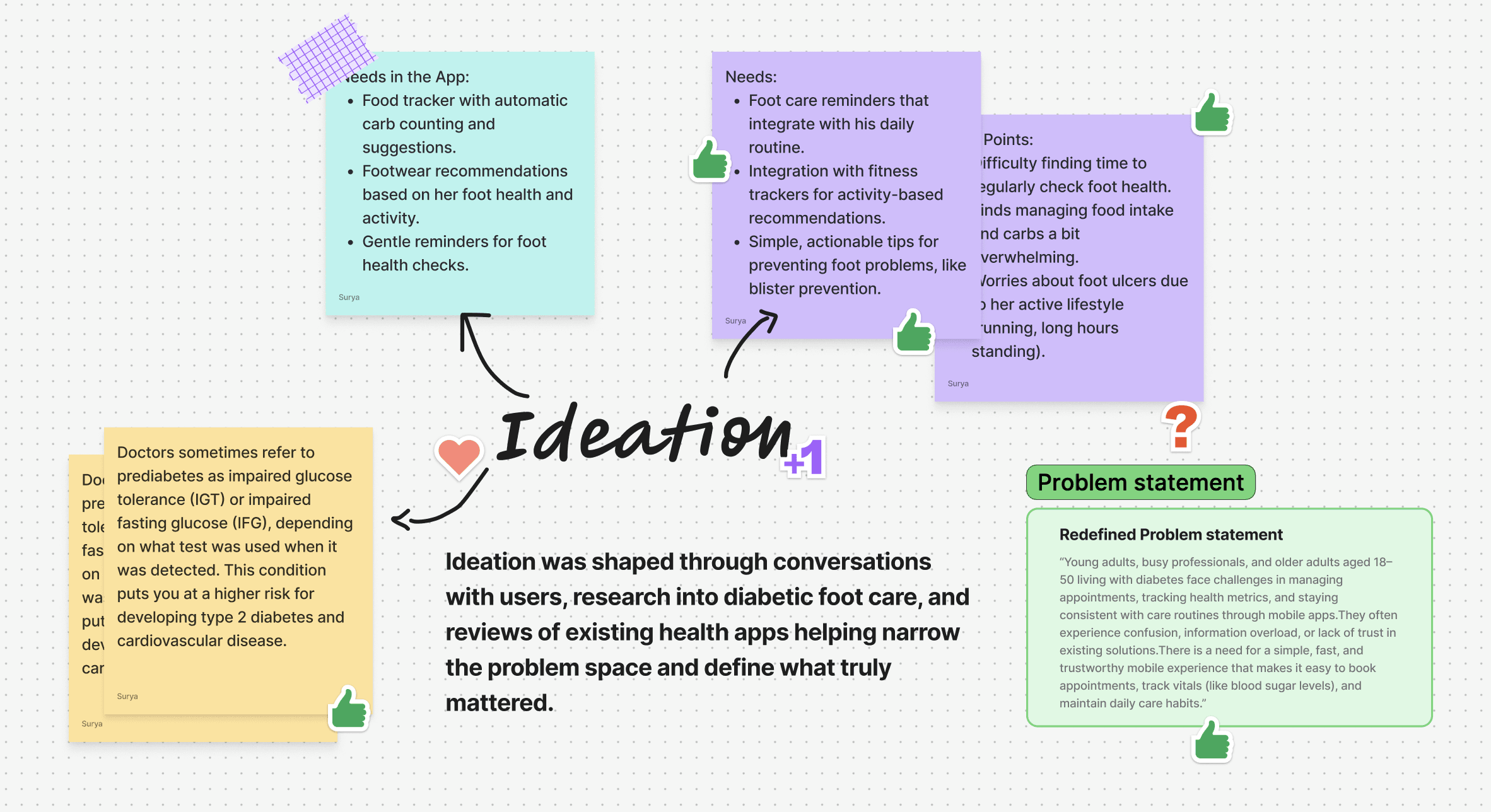
The board captures questions, constraints, and early directions explored before narrowing the solution.
The board captures questions, constraints, and early directions explored before narrowing the solution.
My Approach
My Approach
Participant Recruitment: Purposive sampling was used to recruit 12 participants stratified by:
6 with active foot symptoms (ages 40 to 60)
6 without symptoms (ages 18 to 35)
Inclusion criteria: Diagnosed with Type 1 or Type 2 diabetes for at least 6 months, smartphone user, and able to provide informed consent.
Participant Recruitment: Purposive sampling was used to recruit 12 participants stratified by:
6 with active foot symptoms (ages 40 to 60)
6 without symptoms (ages 18 to 35)
Inclusion criteria: Diagnosed with Type 1 or Type 2 diabetes for at least 6 months, smartphone user, and able to provide informed consent.
What I found:
5 of 6 younger users had never inspected their feet
No participants knew footwear affected foot health
Users responded well to the idea of simple, actionable reminders
"If I get reminders like moisturise today or check for dryness, that sounds useful actually."
What I found:
5 of 6 younger users had never inspected their feet
No participants knew footwear affected foot health
Users responded well to the idea of simple, actionable reminders
"If I get reminders like moisturise today or check for dryness, that sounds useful actually."
Insight: Users are not unmotivated. They lack cues and knowledge. This shifted my focus from persuasion to enablement.
Insight: Users are not unmotivated. They lack cues and knowledge. This shifted my focus from persuasion to enablement.
Key insight: Users are not lazy. They lack cues and knowledge. This reframed my challenge from persuasion to enablement.
Key insight: Users are not lazy. They lack cues and knowledge. This reframed my challenge from persuasion to enablement.
User Research
User Research
Mapping the Experience
Mapping the Experience
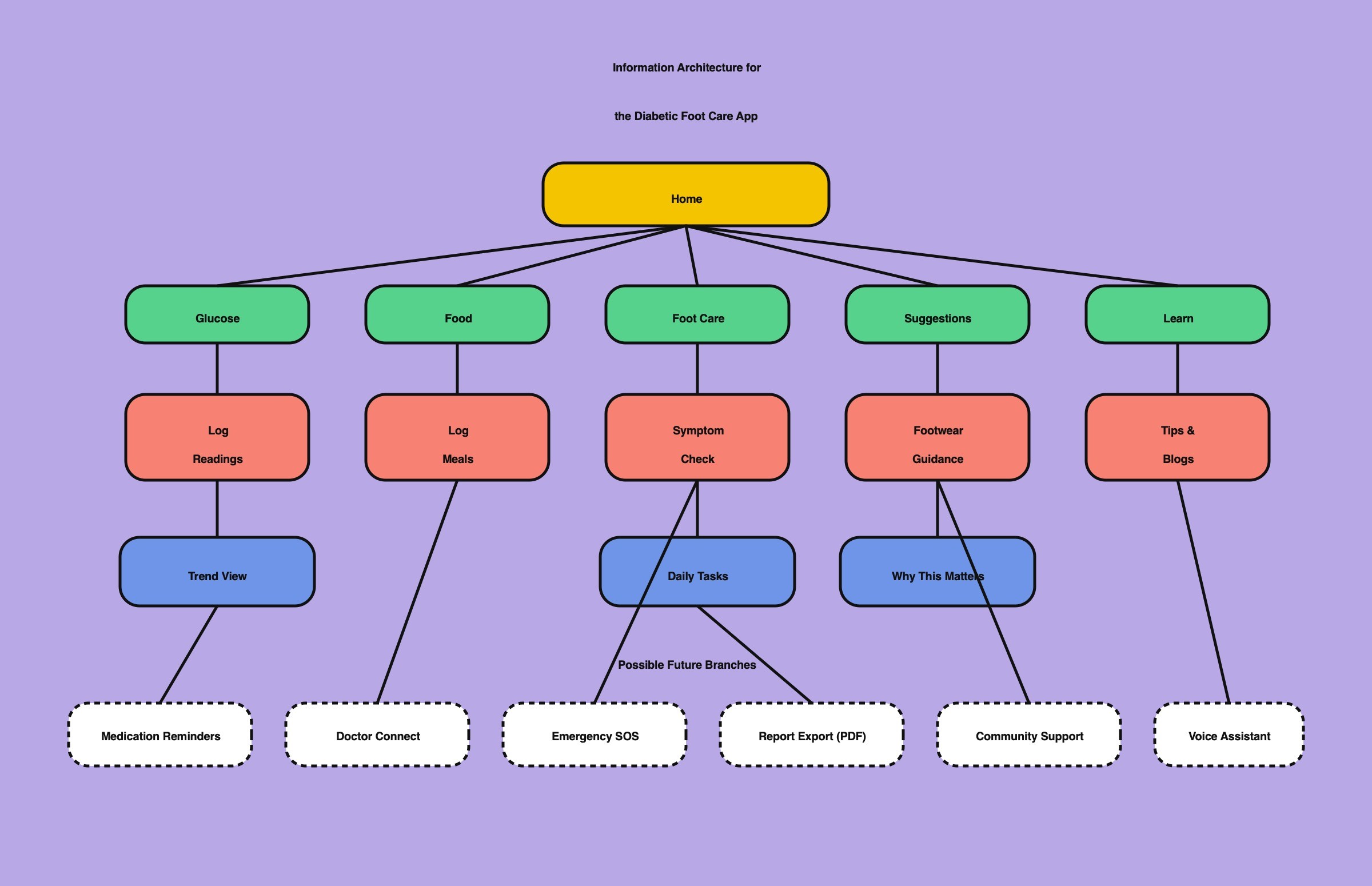
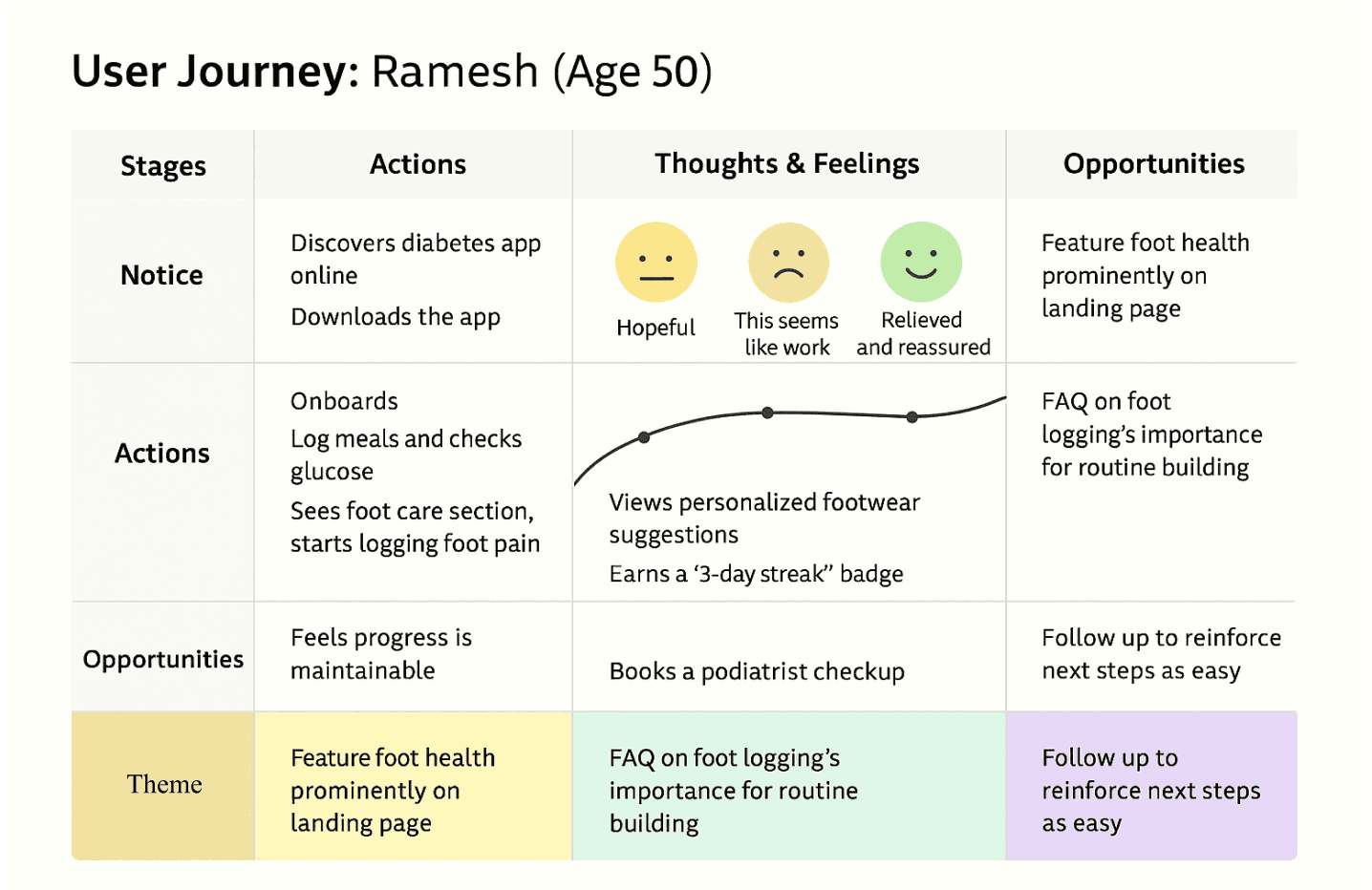
Mapping structure and experience before moving to screens.
Mapping structure and experience before moving to screens.
Problem
Problem
Working through ambiguity
Working through ambiguity
I broke the problem into small questions: when should the foot care surface be? How much attention should it ask for? What would users realistically do daily?
I broke the problem into small questions: when should the foot care surface be? How much attention should it ask for? What would users realistically do daily?
What the research revealed:
7 apps analysed. None included foot care features.
18+ months gap between symptoms and receiving footwear guidance from doctors
Fear-based messaging caused disengagement. Calm framing sustained interaction.
What the research revealed:
7 apps analysed. None included foot care features.
18+ months gap between symptoms and receiving footwear guidance from doctors
Fear-based messaging caused disengagement. Calm framing sustained interaction.
Design Rationale
Design Rationale
Preventive Awareness Over Clinical Monitoring
Preventive Awareness Over Clinical Monitoring
Rationale
Rationale
Existing apps prioritise clinical metrics like glucose and HbA1c, which users aged 40 to 60 found overwhelming. Reducing complexity became a core design goal.
Existing apps prioritise clinical metrics like glucose and HbA1c, which users aged 40 to 60 found overwhelming. Reducing complexity became a core design goal.
Why this mattered
Why this mattered
Clinical tracking dominated every app I reviewed. Users found it exhausting, not helpful for daily habits.
Clinical tracking dominated every app I reviewed. Users found it exhausting, not helpful for daily habits.
What I intentionally included
What I intentionally included
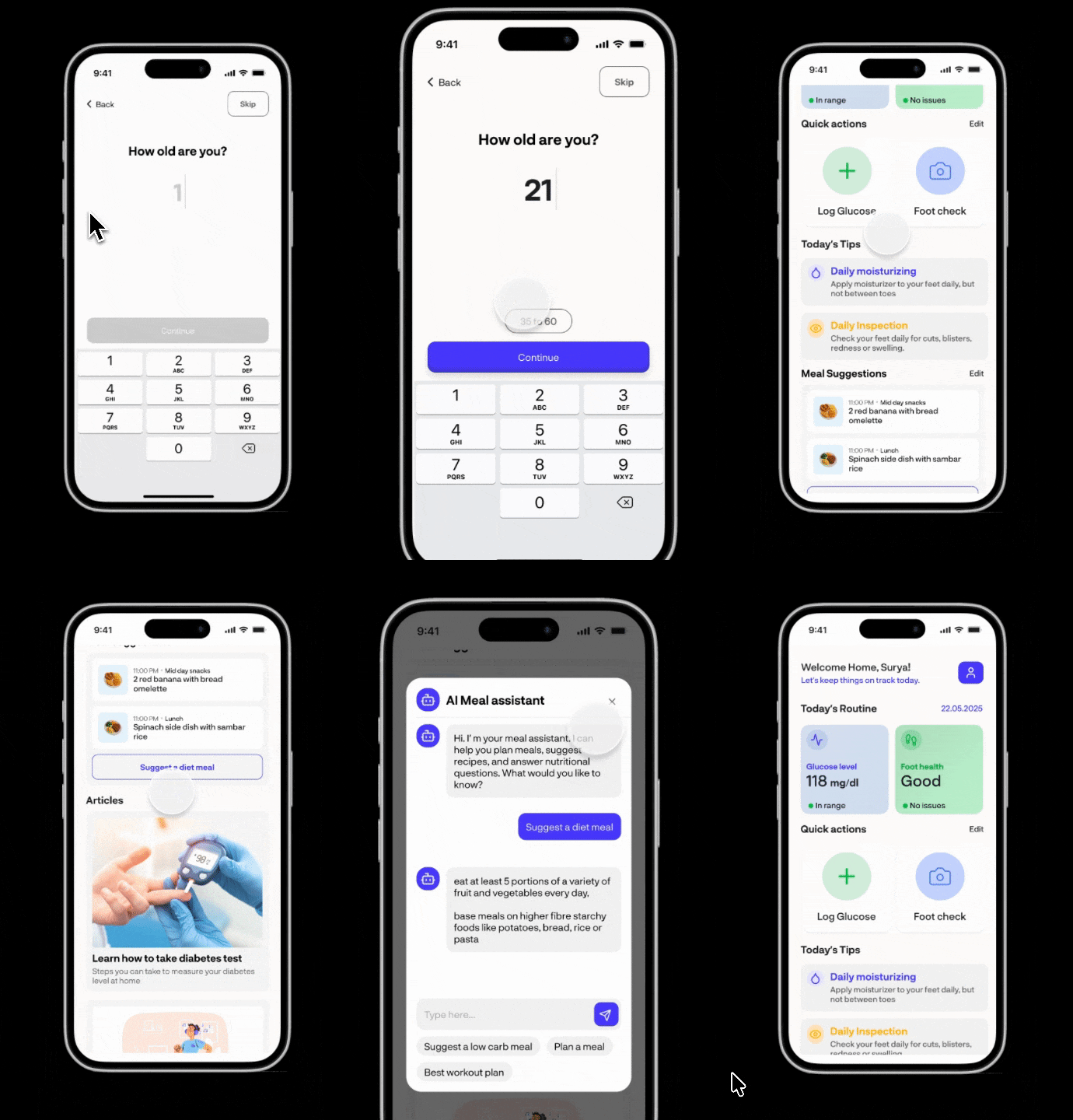
A lightweight foot log supports awareness over time using simple status cues instead of detailed measurements.
A lightweight foot log supports awareness over time using simple status cues instead of detailed measurements.
What I intentionally avoided
What I intentionally avoided
I explored continuous metrics and scoring early on but removed them. They added anxiety without supporting daily awareness.
I explored continuous metrics and scoring early on but removed them. They added anxiety without supporting daily awareness.
Breaking foot care into small daily actions
Breaking foot care into small daily actions
What I chose
What I chose
Foot care was designed as a series of small, manageable actions rather than a single, overwhelming checklist.
Foot care was designed as a series of small, manageable actions rather than a single, overwhelming checklist.
Why this mattered
Why this mattered
Users across all ages responded to simplicity. Gentle prompts like "check for dryness" felt genuinely useful to them.
Users across all ages responded to simplicity. Gentle prompts like "check for dryness" felt genuinely useful to them.
What I intentionally included
What I intentionally included
Single-task prompts ("Log your foot condition") rather than multi-step checklists
Single-task prompts ("Log your foot condition") rather than multi-step checklists
and more decisions.
and more decisions.
Design Response (Solution)
Design Response (Solution)
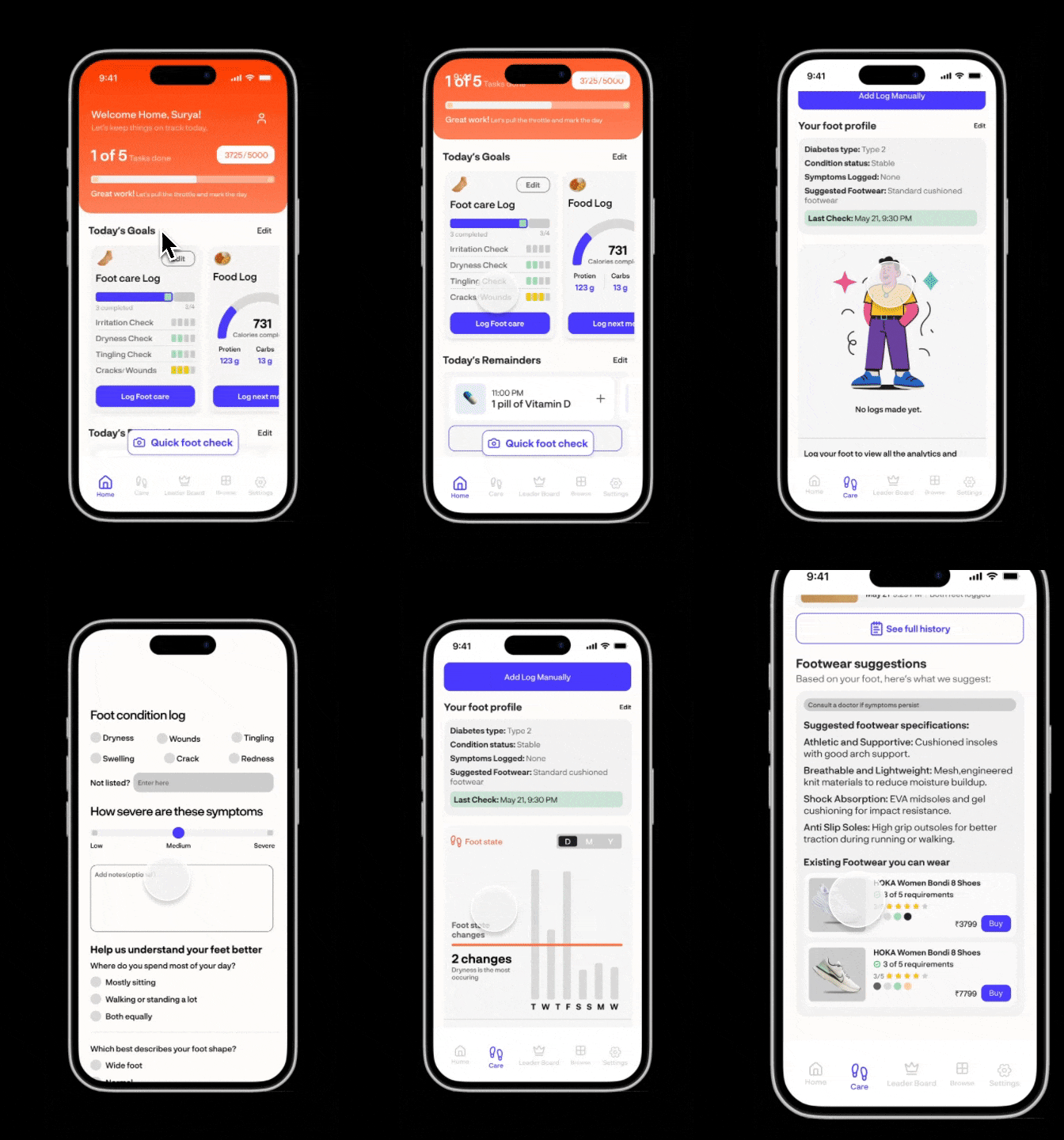
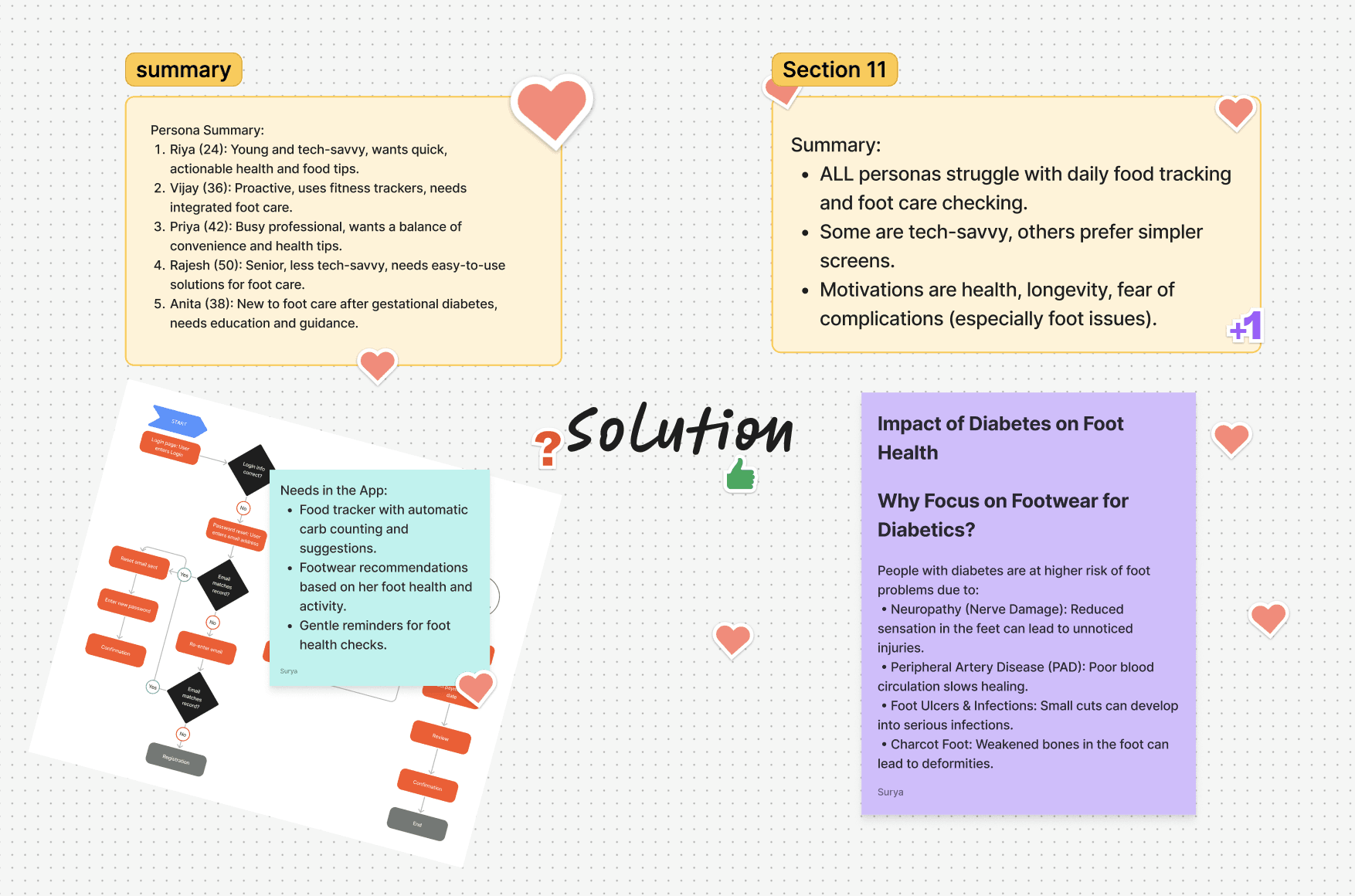
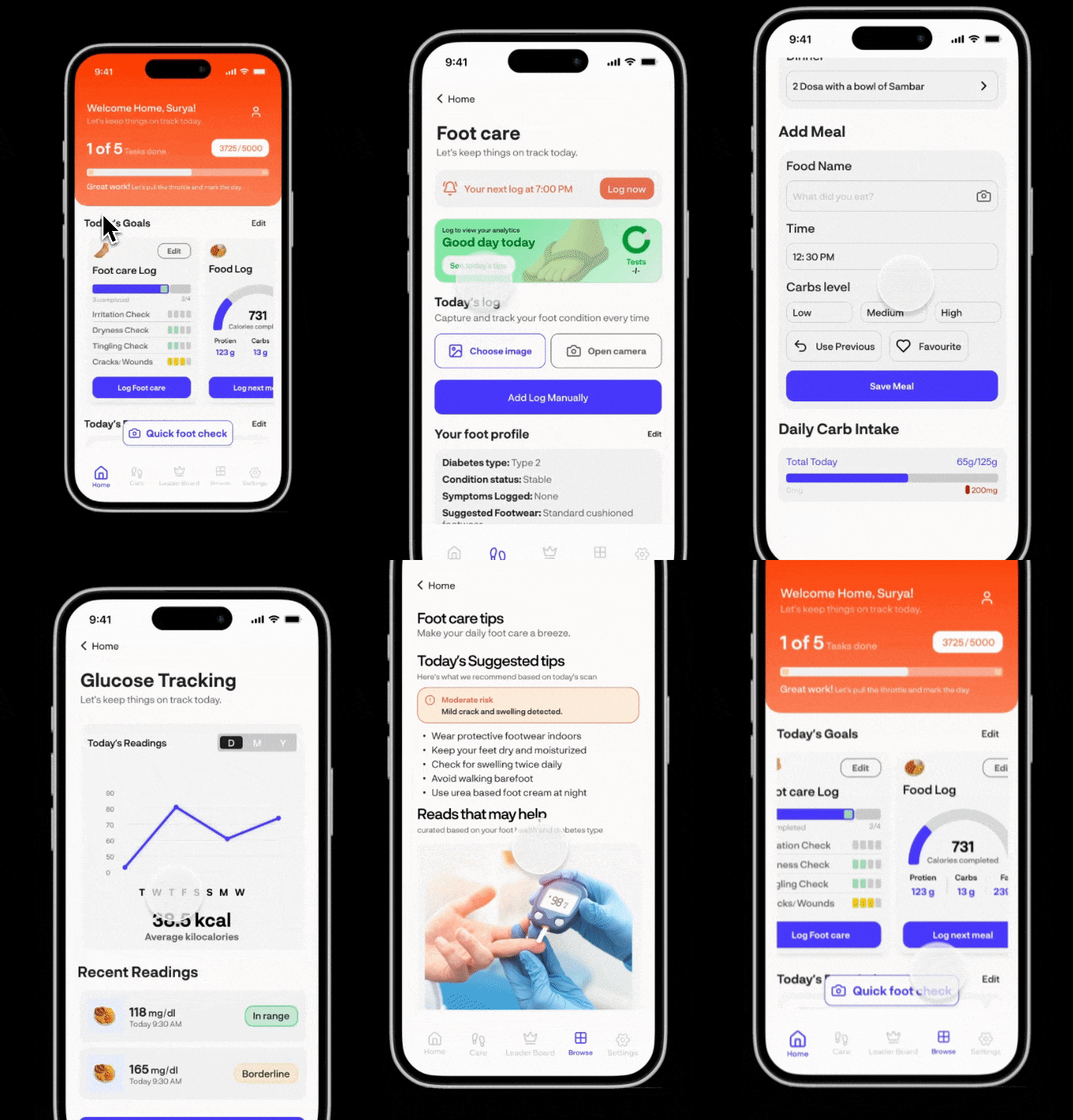
Rather than building another metrics-driven health dashboard, I designed for awareness and habit formation. The prototype centres on three core principles derived from research:
Rather than building another metrics-driven health dashboard, I designed for awareness and habit formation. The prototype centres on three core principles derived from research:
Principle 1: Minimise Cognitive Load Card-based layout. Large touch targets (48×48 dp). High contrast. Minimal text. Users aged 40 to 60 abandoned complex apps. Simplicity was essential.
Principle 2: Emotionally Safe Communication No alerts. No jargon. Calm, supportive phrasing throughout. Early "sad foot" icons were removed after Round 1. Users found them patronising.
Principle 3: Habit Formation Over One-Time Engagement Foot care structured as small daily actions, not checklists. Light acknowledgment ("Logged!") without pressure. Gamification was tested but removed. Users felt it was inappropriate for health.
Principle 1: Minimise Cognitive Load Card-based layout. Large touch targets (48×48 dp). High contrast. Minimal text. Users aged 40 to 60 abandoned complex apps. Simplicity was essential.
Principle 2: Emotionally Safe Communication No alerts. No jargon. Calm, supportive phrasing throughout. Early "sad foot" icons were removed after Round 1. Users found them patronising.
Principle 3: Habit Formation Over One-Time Engagement Foot care structured as small daily actions, not checklists. Light acknowledgment ("Logged!") without pressure. Gamification was tested but removed. Users felt it was inappropriate for health.
Usability Evaluation and Iteration
Usability Evaluation and Iteration
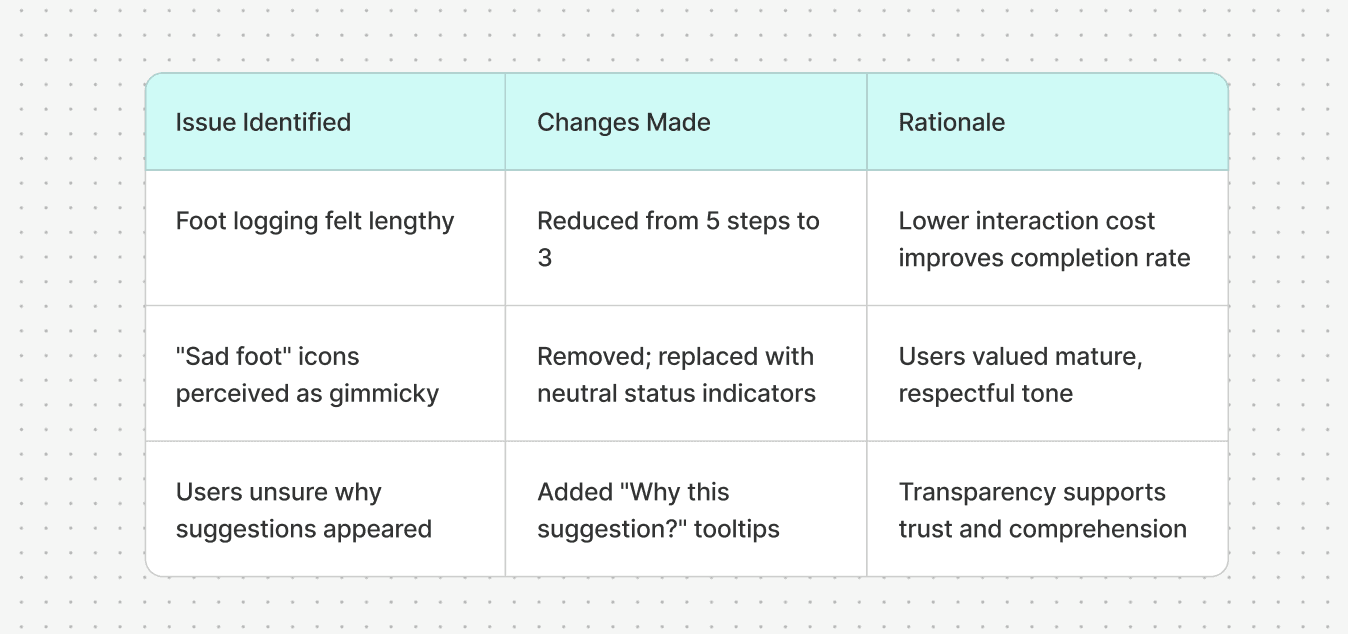
2 rounds of testing (8 + 10 participants) Key changes: Reduced foot logging from 5 steps → 3 Removed "sad foot" icons (users found them gimmicky) Added "Why this suggestion?" tooltips Result: 83% opened twice in 3 days, 90% would recommend
2 rounds of testing (8 + 10 participants) Key changes: Reduced foot logging from 5 steps → 3 Removed "sad foot" icons (users found them gimmicky) Added "Why this suggestion?" tooltips Result: 83% opened twice in 3 days, 90% would recommend
What users actually told me: "This makes me actually check my feet—something I never did." "I never thought shoes matter this much, now I know what to look for."
What users actually told me: "This makes me actually check my feet—something I never did." "I never thought shoes matter this much, now I know what to look for."
Reflection
Reflection
Shifted from reacting to visible problems toward designing for prevention, trust, and long-term behaviour
Learned that removing features (like playful metaphors) can strengthen design when users need a mature, respectful tone
Reinforced the importance of clarity and emotional safety for users already managing health-related stress
Shifted my approach from reacting to visible problems toward designing for prevention, trust, and long-term behaviour.
Learned to work through ambiguity by prioritising judgement over feature completeness — deciding what deserved attention and what should remain intentionally simple.
Reinforced the importance of clarity, emotional safety, and accessibility, especially for users already managing cognitive and emotional load.
Removing playful metaphors was a turning point, revealing that users valued a mature, respectful tone aligned with real health concerns.
Strengthened my interest in research-led, responsible design that supports better decisions over time rather than short-term interaction.
Shifted my approach from reacting to visible problems toward designing for prevention, trust, and long-term behaviour.
Learned to work through ambiguity by prioritising judgement over feature completeness — deciding what deserved attention and what should remain intentionally simple.
Reinforced the importance of clarity, emotional safety, and accessibility, especially for users already managing cognitive and emotional load.
Removing playful metaphors was a turning point, revealing that users valued a mature, respectful tone aligned with real health concerns.
Strengthened my interest in research-led, responsible design that supports better decisions over time rather than short-term interaction.
Limitations
Limitations
Sample size (12 interviews, 18 tests) supports formative research but is not generalisable.
A 3-day testing window cannot validate long-term habit formation. A 4 to 8-week study would be needed.
Testing used a prototype, not a fully functional app with real notifications.
Sample size (12 interviews, 18 tests) supports formative research but is not generalisable.
A 3-day testing window cannot validate long-term habit formation. A 4 to 8-week study would be needed.
Testing used a prototype, not a fully functional app with real notifications.